

I've just started my 16th year of teaching, which doesn't really seem possible. There are plenty of things I do now that I didn't do when I first started teaching, but there are also quite a few things I used to do that I've stopped doing along the way.
Some of them took too much time. Some didn't work the way I thought they would. Others I stopped doing because, somewhere along the way, I realized I didn't actually agree with the reason I was doing them in the first place.
Here are a few things that have disappeared from my classroom over the years.
1. Rewarding Students for Meeting Basic Expectations
Early in my teaching career, I had a ticket system. Students could earn tickets for doing things like coming to class with all of their materials or having a book ready for silent reading without needing to be reminded. They would write their name on the ticket and put it into a jar. At the end of the week, I would draw a few tickets and those students would get a prize. The more tickets you earned, the better your chances of winning.
It seemed like a good system at the time. I was rewarding positive behaviour instead of focusing on negative behaviour, and students generally liked earning the tickets. Then I overheard a student say that my prizes weren't "worth it," so he wasn't going to bother trying to earn tickets anymore.
That really stuck with me. If bringing your materials to class was only worth doing when there was a prize attached to it, what happened when I took the prize away? I didn't actually want students bringing a pencil to class because there was a chance they might win something on Friday. I wanted them bringing a pencil because coming to class prepared is part of being a student.
I stopped using the tickets.
That's not to say I never recognize students for doing something well. I absolutely do. I just don't want there to be a transaction attached to basic classroom expectations.
2. Classroom Jobs
I also used to assign classroom jobs. There would be students responsible for different tasks around the room, and I thought this would help students take some ownership of our classroom. Instead, I found it sometimes did the opposite.
If something needed to be done, students started looking at whose job it was. If it wasn't their assigned job, why should they do it?
Eventually, I decided that I would rather have everyone responsible for our classroom. If there is garbage on the floor, you don't need to be the official garbage-picker-upper to pick it up. If something needs to be put away, put it away. If chairs need to be straightened, we can all straighten them. I want students to see our classroom as a shared space that we all take care of, not a collection of tasks that only matter when your name is beside them.
3. Homework for the Sake of Homework
This one changed because of a conversation with a principal.
I had a student who would not do any of the practice work I assigned. It was frustrating because I couldn't figure out how to get this student to complete the work. The strange part was that the student was doing well on assessments. I was talking to my principal about it one day and asking for advice. How could I get this student to do the assigned work?
She asked me a very simple question: "Why do they need to?"
I remember being a little shocked by the question. "Because it was assigned!"
But her point was that if the purpose of the assignment was to give the student practice, and the student was already demonstrating that they understood the material without that practice, why did they actually need to do it? That conversation really shifted my thinking.
Practice is important, and most students need it. But completing an assignment isn't the goal. Learning is the goal. If I can't explain why a student needs to do something beyond "because I assigned it," that's probably worth thinking about.
4. Grading Everything
Along the same lines, I used to think that if students did something, I needed to mark it. I don't anymore.
I especially don't grade math practice. Every math assignment I give now has an answer key included. Students are expected to do the questions, check their own answers and look for mistakes. Then, when they come back to class the next day, they can ask questions about anything they didn't understand. If they got a question wrong but can't figure out why they got it wrong, that's a useful question for us to talk about.
I don't need to take home 30 math assignments, put checkmarks and corrections all over them and hand them back a few days later for students to find out that they misunderstood question 7. They can find that out immediately and start figuring out what went wrong. Practice is where students are supposed to make mistakes. It doesn't need a grade attached to it.
5. Doing Things Students Can Do Themselves
I think I spent a lot more time doing things for students when I was a newer teacher. Now, I try to ask myself whether something I'm doing actually needs to be done by me.
If students are away, I don't need to track them down and give them every piece of paper they missed. I have an extra-copies crate in my classroom, organized by subject, and students know where to find what they need.
I've also built time into our week for students to catch up, get organized and ask questions. Every Friday, we have a tutorial block. Students can use that time to finish work, study, organize their binders, practice skills or get help with something they don't understand.
I've stopped doing a lot of prep work for students, too. If we're doing an art project and something needs to be cut out, students can cut it out. If we're playing a matching game in French, students can cut out their own cards before they play. I do not need to spend my evening cutting out 30 sets of matching cards so that my students can save five minutes of class time the next day.
There are obviously things I still need to prepare ahead of time, but I've become much more protective of my time outside of school. If students are capable of doing part of the preparation themselves, I usually let them.
6. Making Bulletin Boards
I used to put more effort into bulletin boards and classroom displays. Then I realized that my students really weren't looking at them. Now, I'd much rather use that space to display student work.
Students do notice when their own work goes up. They're proud of it. They show their friends. They look at what other students created. The classroom ends up looking like the students who actually spend their days in it rather than something I put together for them.
It also means I don't have to spend hours designing and changing bulletin boards, which is a pretty nice bonus.
7. Taking Student Behaviour Personally
This one probably took experience more than anything else. I work with children. Sometimes children have big feelings. Sometimes a 13-year-old is going to be angry. Sometimes they're going to roll their eyes. Sometimes they're going to say something mean or insensitive. Sometimes they're going to walk into my classroom already having a terrible day because of something that happened at home, at lunch, in the hallway or in the class before mine.
That doesn't mean I ignore inappropriate behaviour. I still address it, but I don't need to take it personally. I am a grown adult. I can distance myself from the behaviour of a 13-year-old and recognize that whatever is happening with that student doesn't have to ruin my day, too.
I don't think I was as good at doing that when I first started teaching.
Sixteen Years Later...
When I think about how my teaching has changed over the past 16 years, a lot of it has actually been about doing less. I do less rewarding, less marking, less cutting, less decorating and less chasing after students.
But doing less myself doesn't necessarily mean less is happening in my classroom. In a lot of cases, it means my students are doing more. They're checking their own work. They're finding the papers they missed. They're preparing their own materials. They're figuring out what they need help with. They're taking care of a classroom that belongs to all of us.
I'm sure there are things I'm doing right now that I'll look back on in another ten years and wonder why I ever bothered. That's part of the adventure.
So how about you? Has your teaching changed since you started? Let me know how in the comments.

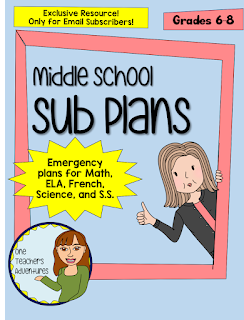
Looking for more great tips and ideas for middle school? Subscribe to my email list and receive an exclusive FREE sub plans resource. It includes plans for math, ELA, science, social studies, and Core French. Click here to subscribe.
Comments
Post a Comment